
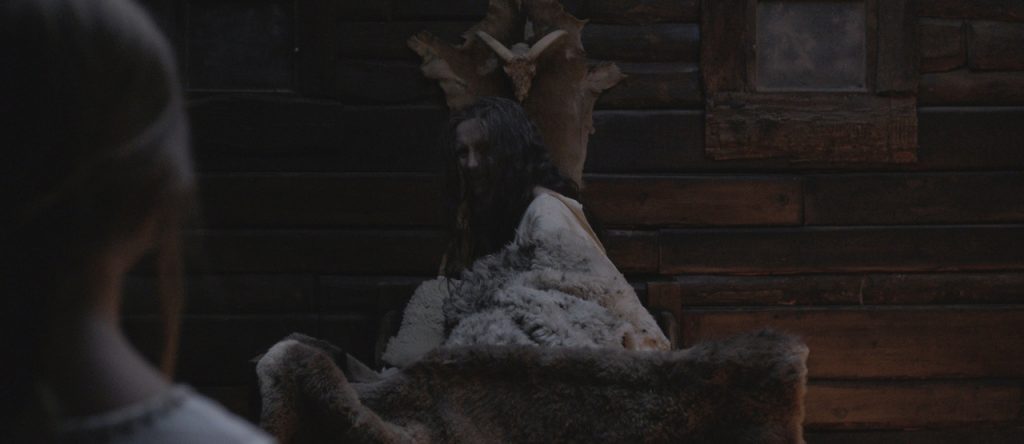
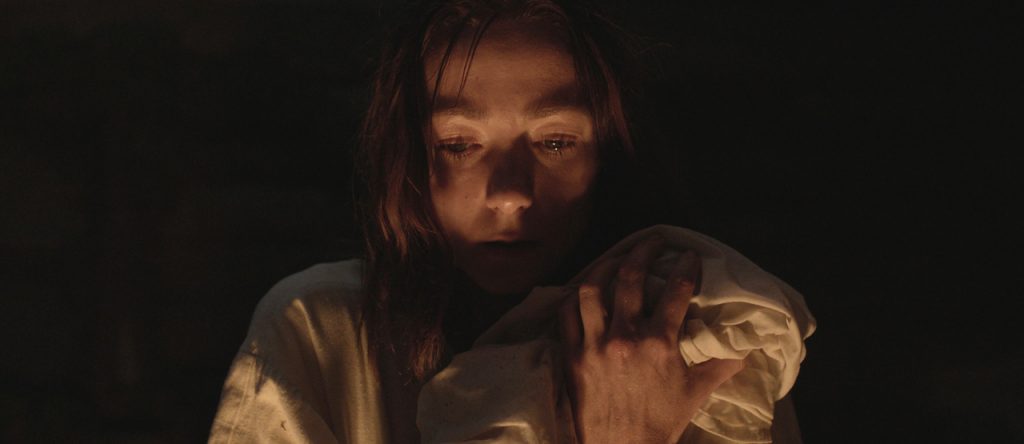
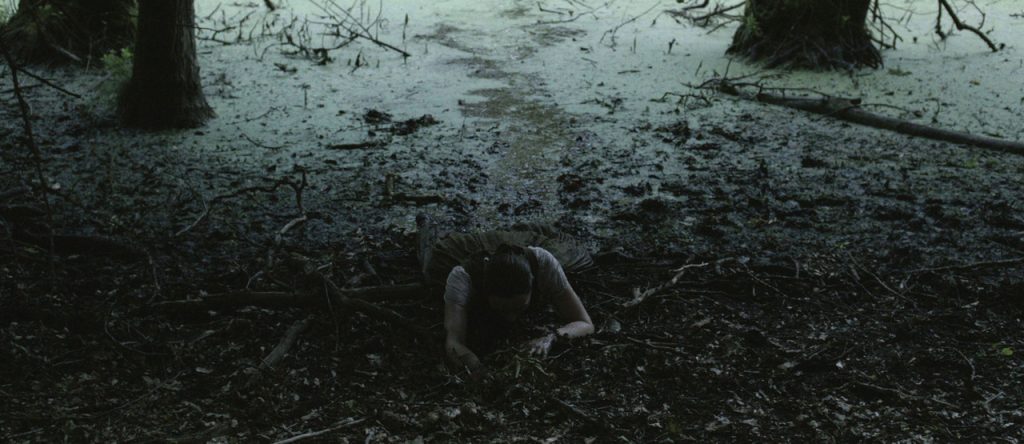
The clock’s ticking… GEGENkino 2018’s starting today at 9pm at Luru Kino in der Spinnerei with Lukas Feigelfeld’s massive witch hunt flick Hagazussa – proof that there’s still some great unseen German horror films.
| 05 April 2018 Luru Kino | OPENING FILM |
| 9 PM | HAGAZUSSA – A HEATHEN’S CURSED AT 2017, 102’, DCP, Director: Lukas Feigelfeld OmeU/OV with English subtitles |
HAGAZUSSA – A HEATHEN’S CURSED
AT 2017, 102’, DCP, Director: Lukas Feigelfeld, Actors: Aleksandra Cwen, Claudia Martini, Tanja Petrovsky, OmeU/OV with English subtitles
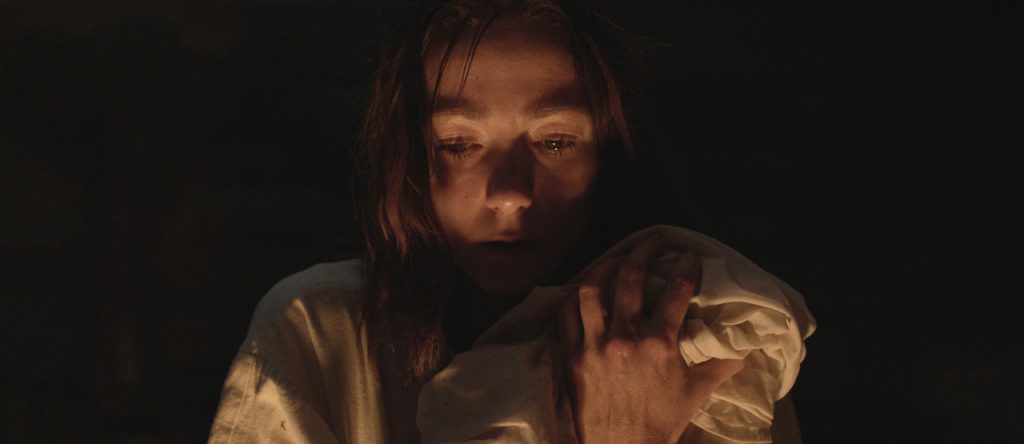
The young Albrun must witness how her mother is stigmatized as a witch and finally consumed by the plague in the medieval solitude of the Alps. Many years later, she still lives outside of the vil-lage, tends goats, cares about her newborn and avoids the company of the community. When a newly-acquired friendship turns bitter, Albrun gives free rein to her shadowy soul. Lukas Feigelfeld’s graduation film at the dffb is an atmospheric horrorfilm, an original piece of genre art that does not exhaust itself in the processing of standard situations. HAGAZUSSA in fact dares to step out of the overly secure terrain of the familiar, and hypnotically tells a story of loneliness and delusion, superstition and violence. In the face of the outcast, landscapes become apparent, shaped by privations and abominations. While the visual arrangements unclose an opulent expanse, the cello of the doomy drone soundtrack re-lentlessly creeps into the depths of subconscious. A film that tracks one, touches, erodes.
GEGENkino 2018 starts tomorrow! Can you believe it?
You can still get your festival tickets—for 38 or 32 (reduced) euros—at Filmgalerie Westend (Industriestraße 18), in the bookstore “W. Otto Nachf.” (Wolfgang-Heinze-Straße 12a), at Riso Club Leipzig (Hermann-Liebmann-Straße 88) or tomorrow on the spot:
| 05 April 2018 Luru Kino | ERÖFFNUNGSFILM |
| 21 Uhr | HAGAZUSSA – A HEATHEN’S CURSED AT 2017, 102’, DCP, Director: Lukas Feigelfeld OmeU/OV with English subtitles |
Here’s some in-depth words about Hagazussa by Karsten Munt for critic.de:
»Es ist stets die psychische Konstitution seiner Protagonistin, für die sich Feigelfeld interessiert. Die fackeltragenden Häscher, die noch zu Beginn des Films in schauerlicher Nacht auftreten, werden alsbald von gewöhnlichen Dorfbewohnern ersetzt, deren Ressentiments Albrun weiter in die Abgründe ziehen. Auf diesen Abgrund konzentriert Feigelfeld das ganze Repertoire des Genrekinos, das er in den letzten Kapiteln seiner Geschichte entfesselt. In Wellen, getragen vom sakralen Drone-Getöse des Soundtracks und den mal verzerrten, mal durchdringend klaren Babyschreien, breiten sich Albruns Delirien auf der Leinwand aus. Die Motive dazu sucht Mariel Baquieros Kamera ebenfalls nicht in greller Verzerrung, sondern im natürlichen Licht, das den natürlichen Ekel, das Delirium des Drogenrauschs und das Röcheln des Todeskampfes stets als das Ende einer langen Tortur zeichnet, deren Ursprung nie in den Schauern von Hexerei und Okkultismus liegt. Die Quelle des Wahnsinns züchtet Feigelfeld unter der Haut einer von Angst durchsetzten Gesellschaft.«
critic.de | Hagazussa – Der Hexenfluch
As you may know, on Sunday, 6pm, at Luru Kino you’ll get the rare chance to hear some of the Ernst Karel’s sound works as part of our homage to Harvard’s Sensory Ethnography Lab; namingly:
MORNING AND OTHER TIMES
USA 2014, R: Ernst Karel, Audio, 30’
SWISS MOUNTAIN TRANSPORT SYSTEMS, RADIO EDIT
USA 2011, R: Ernst Karel, Audio, 55’
Here’s an excerpt from Aby Bliss’ review of SWISS MOUNTAIN TRANSPORT SYSTEMS for British magazine The Wire #333:
»[E]ven devoid of context, the sounds trapped on tape are curiously absorbing. They can be both soothing and suspenseful, as on ›Oberterzen-Unterterzen‹, where the low rumble of machinery and a keening wind are punctuated by periodic clankings and brief snatches of birdsong. The sense soon emerges of a landscape idealised yet only half-conquered by humans. The illusion of gliding, godlike, up a mountainside rests upon loud and often ungainly machinery, as heard on ›Stans-Kälti‹, where strains of (stereotypically) Swiss cowbells are almost drowned out by the violent exertions of the funicular train. Karel also hints at coming obsolescence: the helicopter heard on ›Simplon Pass‹ is transporting materials to a road builder, even as systems only recently documented by Karel have since been removed. Transport is less solid than its imposing infrastructure suggests.«
…and some general words on the Sensory Ethnography Lab by The Wire:
»Sensory ethnography has emerged in response to the way that anthropology has represented its human subjects in media, primarily through film. This new discipline, which has its roots in field recordings, sound art and ethnographic films, tries to develop a way of approaching anthropology’s social concerns, maintaining its methodological imperative to clearly and accurately represent its subjects, while at the same time acknowledging that the audience for such research also makes up part of the meaning that it creates. In short, sensory ethnography is an attempt to resolve the subjective, artistic approaches needed to make effective and engaging work out of empirical data, at the same time as accurately representing its observations.«
Only three more days to go only ‘til GEGENkino #5 starts. Here’s our festival trailer and your chance to get a glimpse of the diversity of things in our programme this year. Check it!
Big thanks to Katharina Wittmann for the teaser!
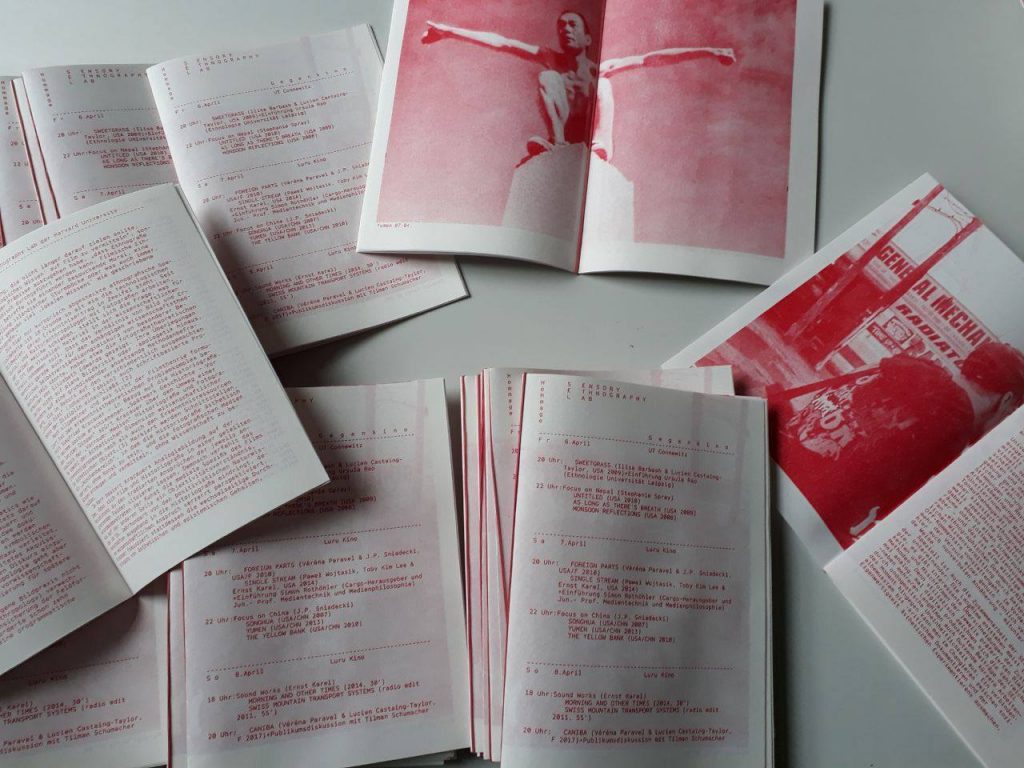
The booklet for the Sensory Ethnography Lab homage is out! Designed by Sophia Eisenhut. Also available as online and download version: https://view.publitas.com/gegenkino/sel-2018